Vertical Framing Explained: Telling Stories in a 9:16 Frame
Close-ups, stacked compositions and props held near faces: how filmmakers compose scenes for a vertical phone screen, and what it changes about storytelling.
Most film and television is composed for wide screens. Vertical short dramas flip the frame to 9:16, the shape of a phone held upright. That simple change affects nearly every decision about where actors stand, how scenes are lit and what the audience can see.
What a vertical frame favours
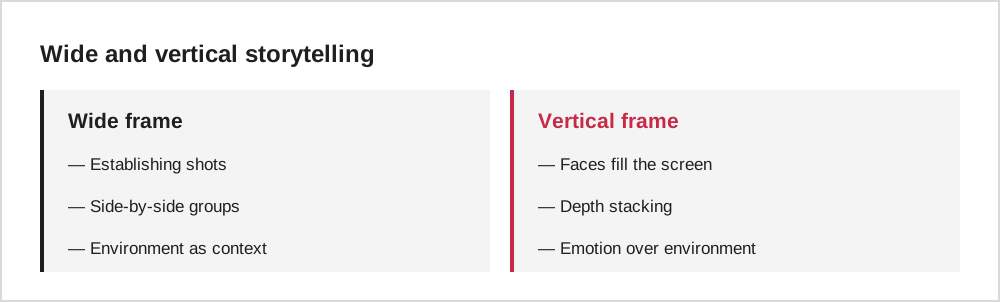
| Works well vertically | Harder vertically |
|---|---|
| Close-ups of one face | Wide landscapes |
| Two people facing each other at an angle | Large groups side by side |
| Standing figures, full height | Car chases and wide action |
| Objects held near the face | Small details in the background |
Stacking instead of spreading
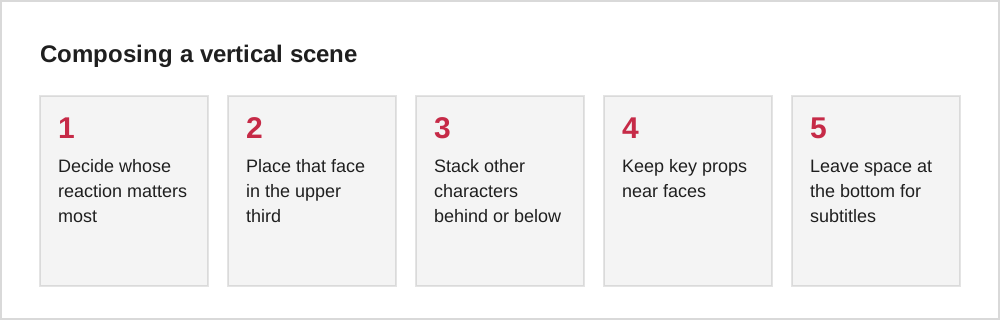
In a wide frame, characters often stand side by side. In a vertical frame, they are more often arranged in depth: one character in the foreground, another behind them. This keeps both faces visible in a narrow frame and adds a sense of tension.
When you watch a short drama, notice how often an important character is shown over another character's shoulder. It is one of the format's signature shots.
Leaving room for the interface
Phone screens are crowded: app buttons, progress bars and subtitles all sit on top of the video. Careful productions keep faces and key actions away from the very top and bottom, where they might be covered.
Lighting and backgrounds
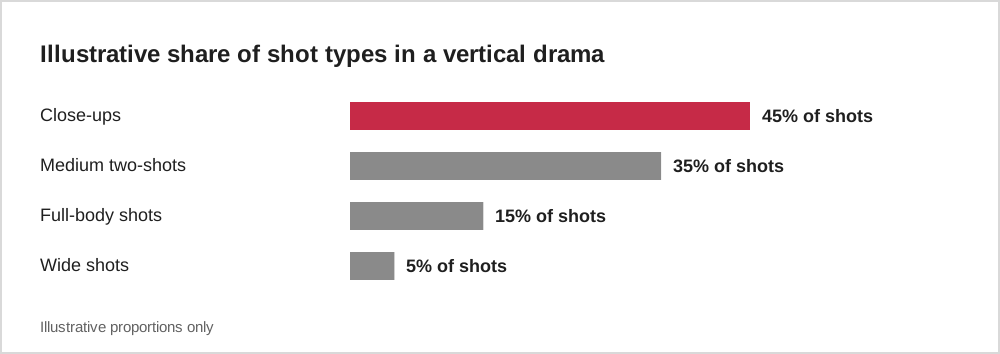
Because faces fill so much of the frame, flattering, even lighting is a priority. Backgrounds are often simple or softly blurred, with a few signature details that signal the setting, such as a chandelier or a city view.
Movement in a vertical frame
Vertical framing also changes how movement is staged. Walking across the frame from side to side is quickly lost in a narrow image, so movement is often directed towards or away from the camera instead. A character striding down a corridor towards the lens, or a door opening behind someone, works naturally in the upright shape.
Camera movement follows the same logic. Rather than sweeping pans, vertical productions often use gentle push-ins on a face, tilts from someone's shoes up to their expression, or a reveal from behind a shoulder. These moves suit the frame and draw attention to emotion, which is what most short drama scenes are built around.
Two people in one tall frame
Conversations are the hardest scenes to frame vertically. On a wide screen, two people can stand side by side. In a tall frame they would each be cut in half or shown very small. Common solutions include placing one actor in the foreground and one behind, shooting each face separately and cutting between them, or using a mirror or doorway to bring both into a narrow space.
Many short dramas rely on quick cutting between close-ups, which suits the fast pace anyway. The over-the-shoulder shot also works well: one character's shoulder fills the lower edge while the other's face fills the upper part of the frame, giving a sense of both people without shrinking either.
Text and graphics on screen
Vertical dramas often add on-screen text: character names and titles when someone new appears, captions for important messages, and stylised sound effects. These elements have to fit within the safe area, away from the app's buttons and the progress bar at the bottom.
Designers usually keep text short and high-contrast, since it will be read on a small screen in varied light. If you make your own vertical videos, test them on an actual phone with the app interface visible. Something that looks centred on a computer monitor may sit right under a like button once uploaded.
Common questions
Can you watch a vertical drama sideways?
You can rotate your phone, but the video will usually appear smaller with bars on each side. The format is designed for upright viewing.
Is vertical filmmaking new?
Vertical video became common with smartphones and short-video platforms. Scripted vertical series have grown more recently, adapting traditional film techniques to the new frame.
The short version
Vertical framing favours faces, depth and emotion over wide spaces. Filmmakers stack characters, keep key props near faces and leave room for app controls and subtitles. Once you notice these techniques, you see them in nearly every scene.