Dubbing, Subtitles and Remakes: How Short Dramas Cross Languages
Some short dramas are dubbed, some subtitled and some reshot with new casts. How localisation works, how to spot each approach, and what it means for viewers.
A short drama you watch in English may have started life in another language. Studios and apps use several approaches to bring stories to new audiences, each with its own strengths and trade-offs. Knowing the difference helps you choose versions you enjoy.
Three ways stories travel
| Approach | What happens | What you notice |
|---|---|---|
| Subtitling | Original audio with translated text | Original performances, reading required |
| Dubbing | Voices replaced in a new language | Easy listening, lip movement may not match |
| Remake | Script adapted and reshot with local actors | Local setting, sometimes changed plot details |
Subtitles: closest to the original
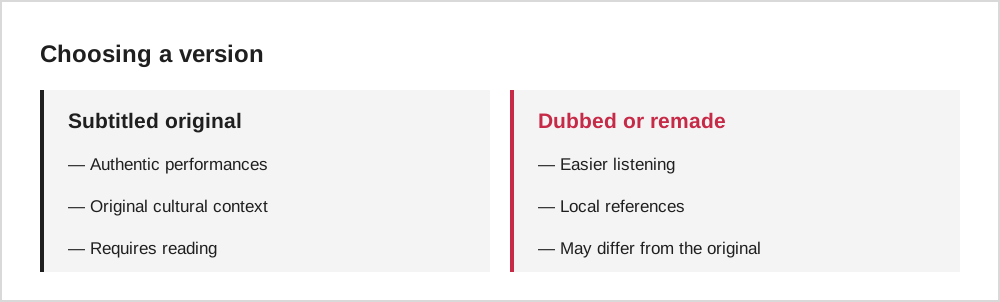
Subtitles preserve the original performances and voices. In short dramas, where lines are short and direct, subtitles are usually easy to follow. They also help in noisy places and for viewers with hearing loss. Our guide to subtitles and accessibility has practical tips.
Dubbing: convenience with trade-offs
Dubbing lets you listen without reading, which suits watching while doing something else. The trade-off is that voices may not match lip movements perfectly, and some emotional nuance can change. Quality varies widely, and some apps let you choose between dubbed and subtitled versions.
If a dubbed version feels flat, try the subtitled original. Many viewers find the original performances more convincing.
Remakes: same story, new world
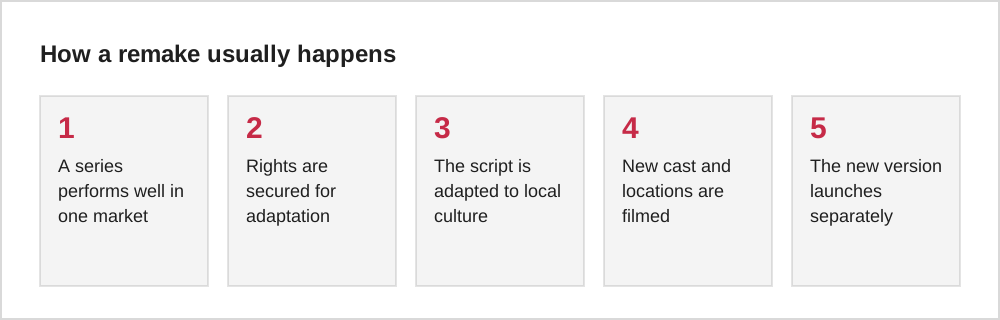
Remakes adapt a story's cultural details: names, settings, social expectations and sometimes plot points. A family duty that drives a story in one culture might be changed to fit another. Remakes can feel more natural to local viewers, though fans of the original may notice differences.
What gets changed in a remake
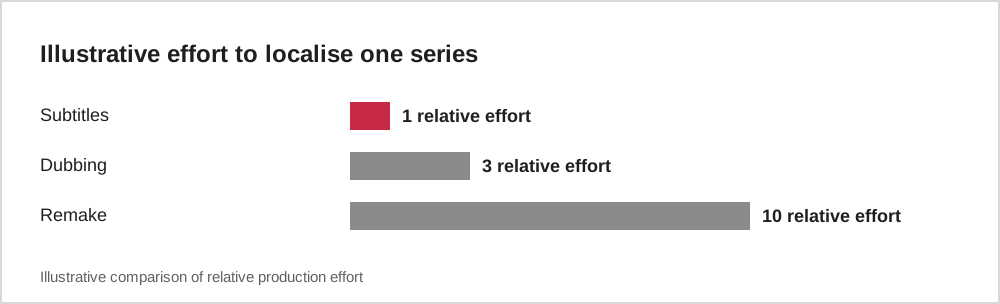
Remakes change more than the language. Names are adapted, settings move to local cities, and social details are adjusted so that motivations make sense to the new audience. A plot that relies on a particular family expectation may be rewritten around a different pressure, such as a business deal or a custody dispute, while keeping the same emotional shape.
Some details are deliberately kept. The core tropes, the order of big reveals and the cliffhanger rhythm usually survive intact, because they are what made the original successful. Comparing an original with its remake, where both are available officially, is an interesting way to see which parts of a story are universal and which are cultural.
How dubbing is produced
Dubbing starts with a translated script adapted to match the length of each line and, ideally, the movement of the actors' lips. Voice actors then record in a studio, often line by line while watching the original scene. A sound engineer mixes the new voices with the original music and effects so that the result feels natural.
Short dramas are sometimes dubbed on tight budgets and schedules, which can show in flat delivery or lines that do not fit the actors' expressions. Higher-quality productions invest in experienced voice actors and careful script adaptation, and the difference is usually noticeable within the first episode.
AI voices and translation
Some studios have begun using AI tools to translate scripts, generate subtitles or even create synthetic voices for dubbing. These tools can make localisation faster and cheaper, which allows more series to reach more languages. They can also produce awkward phrasing, mistimed subtitles or voices that lack emotion.
For viewers, the practical advice is simple: if a dubbed version sounds unnatural, try the original audio with subtitles. Many apps let you switch in the player settings. Subtitled versions usually preserve the actors' performances better, even if they require a little more attention.
Common questions
How can I tell if a series is a remake?
Apps rarely label remakes clearly. Clues include a familiar plot with different actors and settings, or titles very similar to a known series.
Are subtitles always accurate?
Translation quality varies. Short lines are generally easier to translate well, but cultural references and wordplay can be lost.
The short version
Short dramas cross languages through subtitles, dubbing and remakes. Subtitles keep the original performances, dubbing offers convenience, and remakes adapt stories to local culture. Try different versions to see which you enjoy most.