The Contract Marriage Trope: Rules That Are Made to Be Broken
Two people marry for practical reasons, set strict rules, and fall in love anyway. How the contract marriage works in short dramas and why it endures.

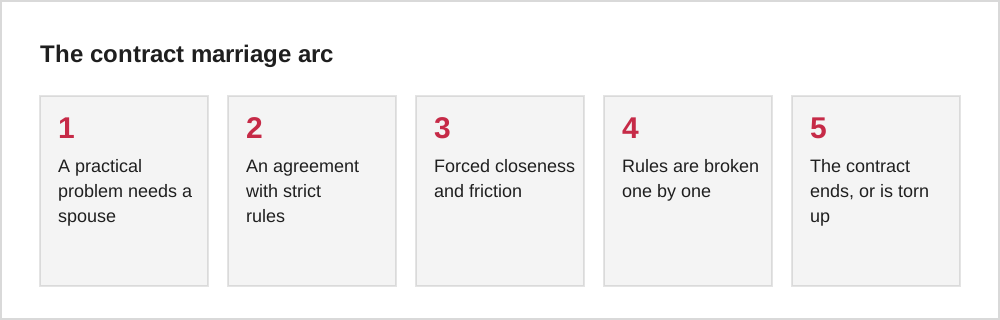
In a contract marriage story, two people agree to marry for practical reasons: to satisfy a family, secure an inheritance, protect a business or solve a crisis. They sign an agreement with clear rules, usually including a date when the marriage will end. Then, inevitably, they start to fall in love.
How the trope unfolds
Why it works
- Built-in tension. The rules tell the audience exactly what the characters are not supposed to do, which makes every broken rule exciting.
- Forced proximity. Sharing a home, attending family dinners and pretending in public create constant opportunities for intimacy and conflict.
- A ticking clock. The contract's end date creates a natural deadline for the romance.
| Common rule | How it usually gets broken |
|---|---|
| Separate bedrooms | A storm, an illness or a visiting relative |
| No public affection | A rival appears and jealousy takes over |
| No falling in love | One partner realises too late they already have |
| Divorce on a set date | The date arrives and neither wants to leave |
Pairings with other tropes
Contract marriages often combine with other tropes: one partner may be a secret billionaire, or the marriage may hide a revenge plan. The combination keeps the story moving when the romance slows down.
The contract document often reappears at key moments, torn, revised or dramatically signed. It works as a prop that tracks the relationship.
What to watch for
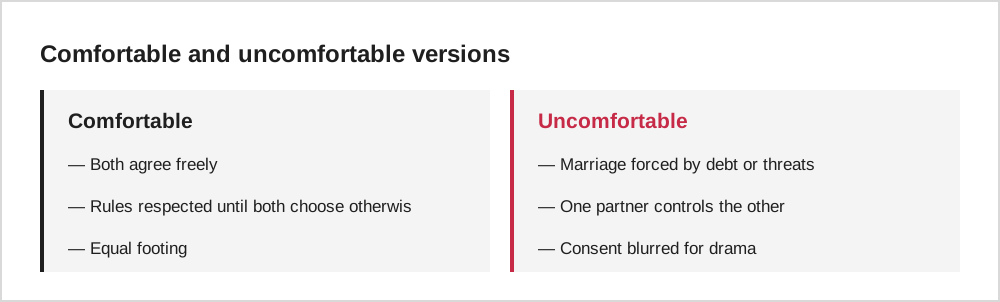
The trope works best when both partners agree to the arrangement freely. Stories that rely on pressure, debt or threats to force someone into marriage can be uncomfortable, especially when that pressure is later treated as romantic.
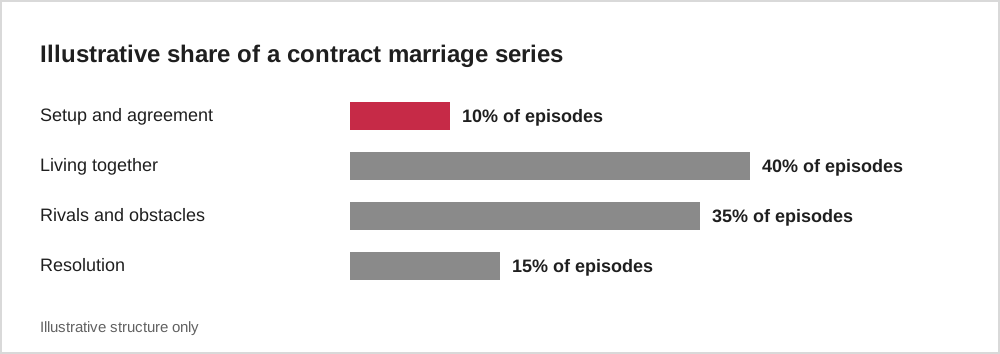
The supporting cast
Contract marriage stories depend on a supporting cast who threaten to expose the arrangement. A suspicious mother-in-law, a jealous ex or a rival at work can each create a scene where the couple must pretend to be in love, often in public. These scenes are where the fake relationship starts to feel real.
The supporting cast also helps pace the story. When the central romance needs to slow down, a new outside threat can keep episodes moving. When it needs to accelerate, a supporting character may discover the contract, forcing the couple to make a real choice sooner.
The contract itself as a story device
The written agreement is often a prop that appears again and again. Early on it sets the rules: a fixed term, separate rooms, no feelings. Later it becomes a source of tension when one partner breaks a rule or when someone else discovers the contract exists. In many series the final act involves the contract being torn up, burned or quietly renewed with new terms.
Writers like the contract because it turns an abstract relationship into something visible. A single shot of the document on a desk can remind viewers of the deadline without any dialogue. When you watch, notice how often the contract returns; each appearance usually marks a stage in the relationship.
Why the deadline matters
Most contract marriages have an end date, such as one year, six months or until a family crisis is resolved. That deadline is a ticking clock that gives the series shape. As the date approaches, the characters must decide whether to separate as agreed or admit that the arrangement has become real.
A deadline also lets writers create natural midpoint and climax moments. Halfway through the term, an outsider might threaten to expose the arrangement. Near the end, one partner might prepare to leave while the other struggles to say how they feel. If a series forgets its own deadline, the story usually loses tension, which is a useful sign of weaker writing.
Common questions
Why is the contract marriage so popular in short dramas?
It creates conflict and intimacy immediately without lengthy setup. Within a few episodes, two strangers share a home and a secret, which is ideal for fast storytelling.
Is the trope unique to short dramas?
No. It appears widely in romance novels, web fiction and television. Short dramas compress it into a fast, highly visual form.
The short version
The contract marriage turns rules into tension and forced closeness into romance, with a built-in deadline. It works best when both partners choose the arrangement, and becomes uncomfortable when coercion is treated as love.