The Secret Billionaire Trope: Why It Works and What to Watch For
The humble partner who turns out to be fabulously rich is the most recognisable short drama story. How it is built, why it satisfies, and its common pitfalls.

If one story defines vertical short dramas for many viewers, it is the secret billionaire. Someone, often a quiet husband, a delivery driver or an overlooked employee, is mocked for being poor. Then the truth arrives: they own the company, the hotel or the whole city block. The people who sneered are left speechless.
How the trope is built
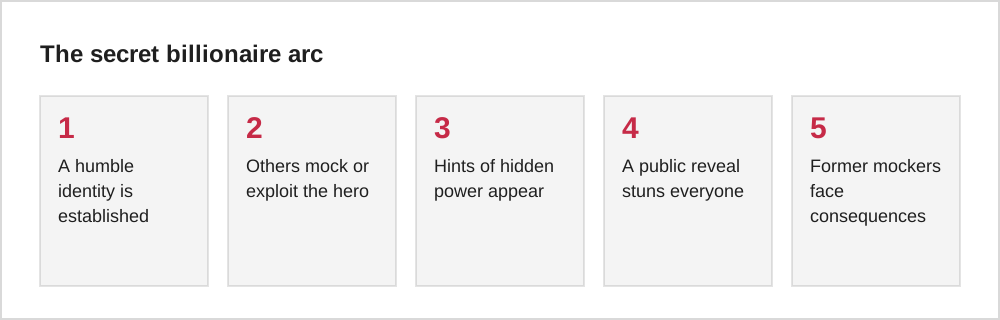
The trope is usually told from the point of view of someone who loves the hidden billionaire without knowing the truth, or of the billionaire themselves, quietly enduring humiliation before choosing the moment to reveal it.
Why audiences love it
- Reversal of humiliation. The pleasure of watching rude characters realise their mistake is one of the most reliable payoffs in the format.
- Wish fulfilment. It imagines a world where kindness is secretly rewarded and wealth arrives with a protective partner.
- Clear stakes. Everyone understands money, status and embarrassment instantly, which suits minute-long episodes.
The reveal scene is often stretched across several episodes, with almost-reveals and interruptions. Spotting this pattern helps you predict when the payoff will actually land.
Common variations
| Variation | What changes |
|---|---|
| The hidden husband | The spouse everyone looks down on is secretly powerful |
| The undercover boss | A company owner works incognito among staff |
| The returning heir | A long-lost child of a wealthy family comes home |
| The double reveal | Both partners are hiding wealth from each other |
The returning heir overlaps with another trope covered in our guide to hidden identities.
What to watch for
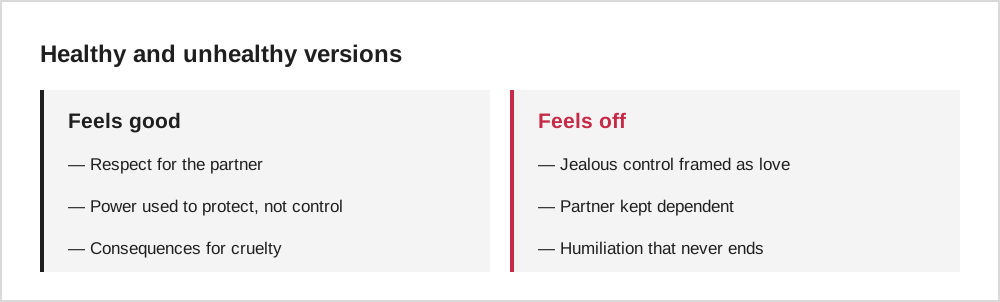
Like many romance tropes, the secret billionaire can drift into uncomfortable territory. Watch for stories that present controlling behaviour, constant surveillance or financial domination as romantic proof of love. A good version of the trope keeps the fantasy of being cherished without romanticising control.
Recognising the reveal build-up
Secret billionaire stories usually build towards the reveal in stages. First, small hints appear: an expensive watch, an unexpectedly respectful stranger, a phone call answered in a commanding tone. Then a near-reveal is interrupted at the last second. Finally, the reveal happens publicly, ideally in front of the people who were most dismissive.
Knowing these stages makes the trope more enjoyable to watch, because you can anticipate the payoff and appreciate how the writers delay it. It also helps you notice when a series is stretching the build-up too far.
A typical first episode, beat by beat
The opening usually follows a familiar sequence. First the heroine is shown in an ordinary job or an unhappy relationship. Then she suffers a public humiliation, perhaps being dumped at a party or insulted by a rich relative. A quiet man nearby witnesses it. Within a minute or two they agree to something impulsive: a quick marriage, a fake date or a deal to help each other.
The final seconds of the episode hint that he is not what he seems: a luxury car waiting outside, an assistant calling him by a formal title, or an expensive watch in close-up. The audience now knows more than the heroine does, and the rest of the series plays on that gap. Each later episode delays the full reveal while giving the audience a little more proof.
How the trope has changed
Earlier versions of the trope often relied on a cold, controlling hero whose possessiveness was presented as romantic. Many newer series soften this. The hero is still powerful, but he respects the heroine's choices, supports her career and earns her trust rather than demanding it. Some series swap the roles entirely, with a secretly wealthy heroine and an ordinary hero.
Viewers increasingly comment on these differences, and apps notice which versions keep people watching. If you prefer the gentler style, the first two or three episodes usually show which kind of hero a series has chosen. Look at how he reacts when the heroine says no to something: that moment tells you a lot about the rest of the story.
Common questions
Why are there so many billionaires in short dramas?
Wealth is a fast, universally understood way to create status reversals, and reversals are what short episodes run on. It is a storytelling shortcut as much as a fantasy.
Is the trope only about romance?
Mostly, but it also appears in family and revenge stories, where hidden wealth becomes a tool for justice rather than love.
The short version
The secret billionaire works because it combines a humiliation, a hidden truth and a public reversal, all of which land quickly on a small screen. Enjoy the fantasy, and notice when a story confuses protection with control.