Hidden Heirs and Secret Identities: The Reveal Trope Explained
Long-lost children, switched babies and secret pasts: how identity reveals create instant reversals in short dramas, and how to tell a good reveal from a lazy one.

Identity reveals are among the most satisfying moments in short dramas. A character treated as worthless is revealed as the true heir of a powerful family. A switched baby discovers where they really belong. A quiet newcomer turns out to have a past nobody suspected. In a single scene, every relationship in the room changes.
Common forms of the trope
| Form | Typical clue |
|---|---|
| The lost heir | An heirloom, a birthmark or a matching photograph |
| Switched at birth | A blood test or a hospital record |
| The secret professional | A sudden display of expert skill |
| The hidden past | An old friend recognises them in public |

Why reveals work so well
A reveal is the fastest possible reversal of status. In one moment, the people who looked down on a character have to rethink everything. That makes reveals ideal for short episodes, which need a strong turn every minute or two. Reveals also generate many follow-up scenes: reactions, apologies, denials and new rivalries.
Many series delay the reveal by having it nearly happen several times. If you notice the third interrupted reveal, the real one is usually close.
Good reveals and lazy reveals

The best reveals are fair: an attentive viewer could have guessed. The weakest rely on sudden coincidences that solve every problem at once.
Pairings with other tropes
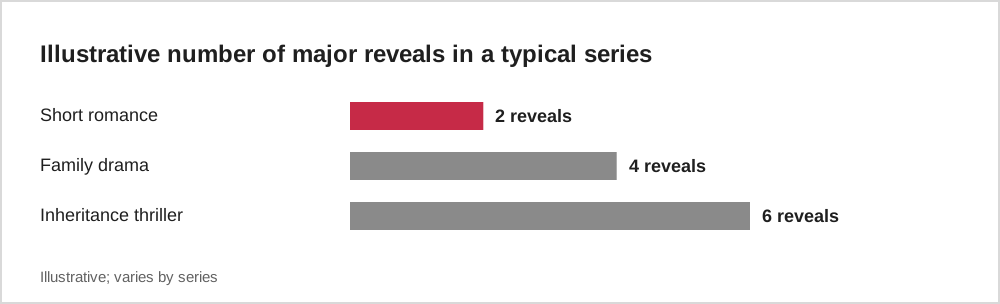
Hidden identities often power secret billionaire and inheritance war stories. A single series may contain several layered reveals, each raising the stakes.
Spotting the clues early
Writers usually plant identity clues early, even if they are easy to miss. Watch for objects that the camera lingers on: a pendant, an old photograph, a scar or a ring. Pay attention to characters who react oddly to the hero's name or face, and to adults who seem to know more than they say. These are often the threads the reveal will pull together later.
Spotting clues is part of the pleasure of the trope. It turns a passive binge into a guessing game, and it helps you judge the quality of the writing. A reveal that ties together several earlier clues feels satisfying; one that relies on a stranger appearing with a document out of nowhere feels like a shortcut.
Who knows the secret
A hidden identity story is shaped by who knows the truth and when. Usually the audience learns first, often in the opening episode. Then one ally learns it, such as a loyal assistant or an old servant, and helps protect the secret. The villains are the last to know, and the series saves their discovery for a big public moment.
Tracking this order is a simple way to follow the plot. Each time a new character learns the secret, the story changes: an ally gains power, a rival becomes dangerous, a romance becomes complicated. If the secret spreads too quickly, the tension drains away; if it never spreads, the story stalls. Good series release it at a steady pace.
Why viewers enjoy being one step ahead
Dramatic irony, knowing something a character does not, is one of the oldest pleasures in storytelling. In hidden identity series it powers almost every scene. When an arrogant cousin insults the heroine, the audience enjoys the insult precisely because they know how badly it will backfire.
This also explains why these series rarely hide the identity from viewers for long. A mystery about who someone really is can work, but it creates a different feeling: curiosity rather than anticipation. Most short dramas choose anticipation because it delivers small satisfactions in every episode, which suits the one-minute format.
Common questions
Why are DNA tests so common in short dramas?
They are quick, visual and decisive. A single document or test result can deliver a reveal in seconds, which suits the format's pace.
Do hidden identity stories always involve wealth?
Often, but not always. Some reveal hidden skills, professions or family connections that matter more for emotional reasons than financial ones.
The short version
Identity reveals deliver instant status reversals, which is why they appear in so many short dramas. The best reveals are set up with fair clues and genuinely change the story; the weakest rely on coincidence.