What Are Vertical Short Dramas? A Beginner's Guide to the Format
Minute-long episodes, filmed upright for phones, released in long series with a cliffhanger every time. What vertical short dramas are and how they differ from TV.
Vertical short dramas, also called micro-dramas or mini-dramas, are scripted series filmed for a phone held upright. Each episode usually lasts between one and two minutes, a full series can run to dozens or even more than a hundred episodes, and nearly every episode ends on a cliffhanger. The format grew rapidly in China, and dedicated apps have since brought it to viewers around the world, often with stories written or remade for English-speaking audiences.
If you have seen an advert for a show about a secret billionaire or a betrayed wife's revenge while scrolling social media, you have probably met the format already.
The format in one table
| Feature | Vertical short drama | Typical TV drama |
|---|---|---|
| Screen orientation | Vertical (9:16) | Horizontal (16:9) |
| Episode length | About 1–2 minutes | 30–60 minutes |
| Episodes per series | Often 50–100 or more | Often 6–20 per season |
| Total running time | Often 1–3 hours | Often 6–15 hours |
| Payment | Usually per episode with coins, or a pass | Subscription or broadcast |
The total running time of a whole series is often similar to a long film. It simply arrives in very small pieces.
Why vertical?
People hold their phones upright most of the time. Filming vertically fills the whole screen without asking viewers to rotate their phone, and it suits close-ups of faces, which carry most of the emotion in these stories. It also changes how scenes are staged: fewer wide shots, more tight framing of one or two people. Our guide to vertical framing explains the craft.
What the stories are like
Short dramas lean heavily on familiar story patterns, or tropes: secret billionaires, contract marriages, hidden heirs, revenge plots, second chances and paranormal romances. Familiar patterns let a story start fast, because the audience already knows the rules. Our trope guide covers the most common ones.
How you watch them
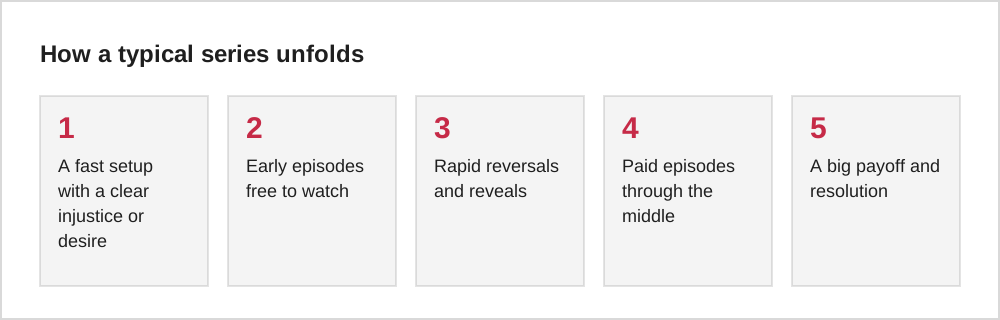
Most short dramas are watched in dedicated apps. A common model is to make the first episodes free, then charge coins or offer a subscription for the rest. Some services also unlock episodes if you watch an ad or complete a daily check-in. The exact system varies by app, which is why we explain how coin systems work in detail.
Before you start a series, check how many episodes it has and how many are free. That tells you most of what you need to know about the cost.
Why people love them
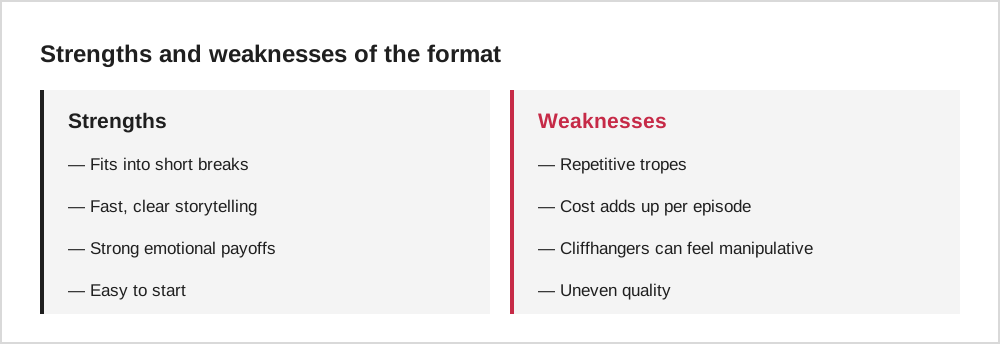
Short dramas are quick, emotional and easy to dip into. A single episode fits into a coffee break, the stories are easy to follow even with the sound low, and the constant reversals deliver satisfaction in small doses. They are also easy to criticise: plots can be repetitive, and the pay-per-episode model can become expensive. Both things can be true at once.
A typical first five minutes
Most series open with an emergency rather than an introduction. In the first episode a bride may be abandoned at the altar, a daughter thrown out of the family home, or a quiet employee humiliated in front of the whole office. You learn who the heroine or hero is through what is done to them, not through a slow tour of their life.
By the third or fourth episode the series has usually shown its central promise: a secret identity, a contract, a revenge plan or a second chance. From there each episode adds one new piece of information and one new obstacle. If you watch five episodes and still cannot say what the promise is, the series is probably not well built, and it is a good moment to stop before the paid episodes begin.
Words you will see in the apps
Apps use a small set of terms. Episodes are the individual clips, usually one to three minutes long. Coins or beans are the in-app currency used to unlock them. A pass, VIP or membership is a subscription that unlocks some or all episodes for a period. Bonus coins are extra coins added to a purchase and may expire sooner than paid ones.
You will also see ad unlocks, which let you watch an advert instead of paying, and check-in rewards, small amounts of free coins for opening the app each day. None of these terms are standard across apps, so read the app's own help page once. Knowing the vocabulary makes it much easier to compare prices, which our coin systems guide explains in detail.
Common questions
Are short dramas the same as clips from longer shows?
No. Most are produced specifically for the format, with scripts written around one-minute episodes and vertical framing. Clips cut from longer series are a different thing.
Are they only in English?
No. The format is produced in many languages, and popular stories are often dubbed, subtitled or remade for other markets. See our guide to dubbing and localisation.
The short version
Vertical short dramas are minute-long, phone-first episodes in long series, built on familiar tropes and frequent cliffhangers, and usually paid for episode by episode. Check the episode count and pricing before you start, and enjoy them for what they are: fast, emotional storytelling in small pieces.